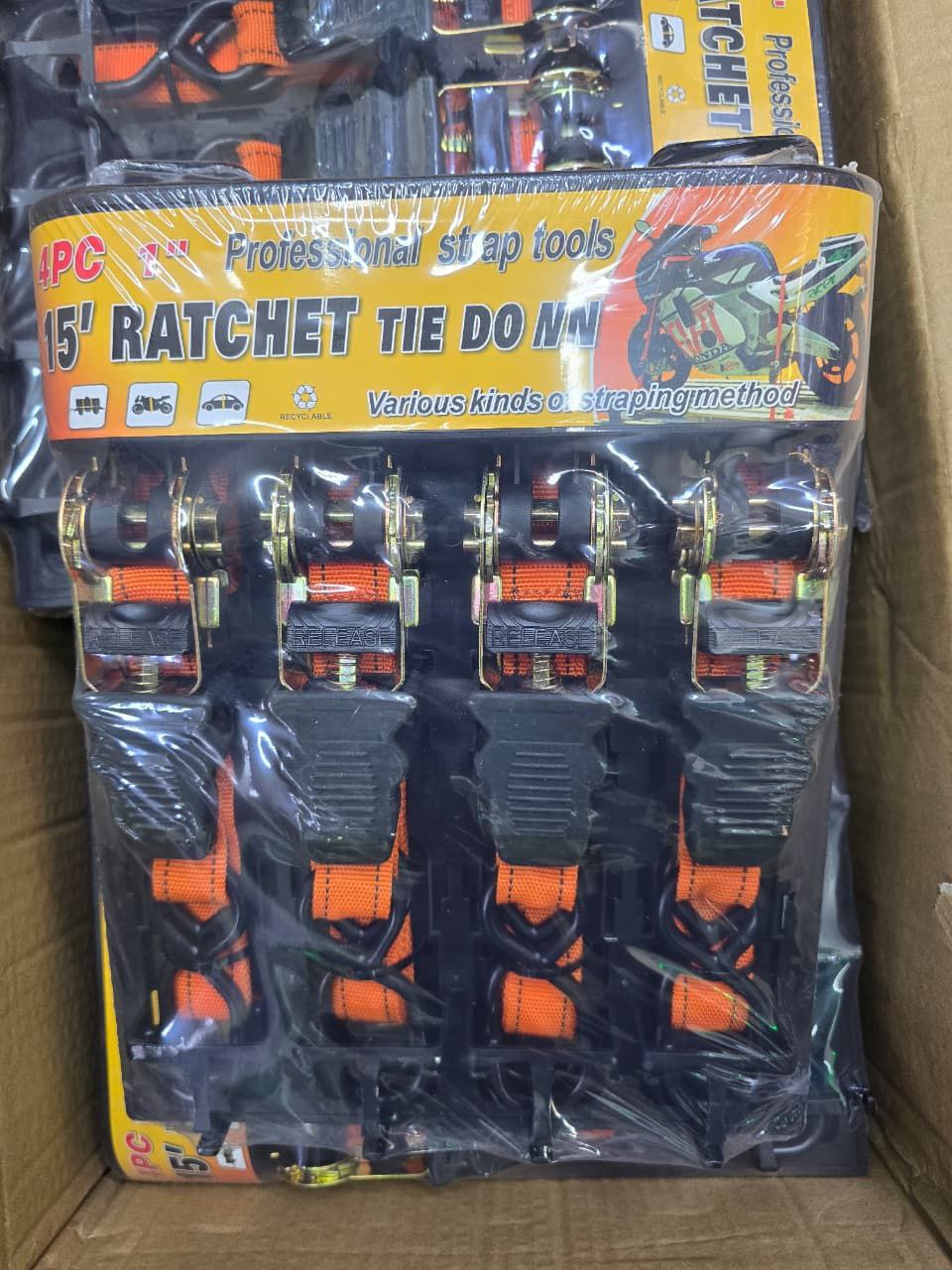
A ratchet tie-down (also called a ratchet strap or lashing strap) is a securement device used to hold down cargo or equipment during transport. It consists of: Webbing (Strap): A strong, durable woven strap, typically made from polyester or nylon, designed to resist stretching, UV degradation, and abrasion. In your case, each strap is 15 feet long. Ratchet Mechanism: This is the core component. It’s a mechanical device with a handle and a gear that allows you to tension the webbing by repeatedly pulling the handle back and forth. This creates a very tight, secure hold on the cargo. End Fittings/Hooks: These are attached to the ends of the webbing and hook onto anchor points on a truck bed, trailer, roof rack, or other securement points. Common types include: S-hooks: Versatile for smaller anchor points. J-hooks (or Double J-hooks): More robust, often used for heavier loads. Flat hooks: For use with flatbed trailers. Wire hooks: Strong and secure, often found on heavy-duty straps. Key Features and Benefits: Secure Load Management: Ratchet tie-downs provide superior tensioning compared to cam buckle straps or ropes, ensuring cargo remains firmly in place, even over rough terrain or during sudden stops. High Strength: They have impressive breaking strength (the force at which the strap will break) and working load limits (WLL – the maximum weight that can be safely secured). For a 15-foot strap, the strength would vary, but it’s crucial to check the specific WLL printed on the label. Durability: Made from robust materials designed for outdoor use and resistance to wear and tear. Versatility: Used in a wide range of applications: Securing furniture, appliances, and boxes in moving trucks or trailers. Tying down motorcycles, ATVs, and lawnmowers. Holding down lumber, pipes, ladders on roof racks or utility trailers. Camping and outdoor gear securement. Ease of Use (once learned): While the ratchet mechanism might seem complex at first, it’s quite straightforward to use for tensioning and releasing the strap. 4-Piece Set: Having a set of four (4pcs) is very practical, as most loads require at least four anchor points for stable and safe securement. Important Considerations: Working Load Limit (WLL): Always check the WLL printed on the strap. This is the maximum weight that can be safely secured. Never exceed this limit. The aggregate WLL of all straps used should be at least 1.5 times the weight of the cargo. Breaking Strength (BS): This is typically 3 times the WLL. Strap Width: Wider straps generally have higher WLLs (e.g., 1-inch, 1.5-inch, 2-inch widths). Length: You’ve specified 15 feet. Common lengths also include 10ft, 20ft, and 27ft. End Fittings: Ensure the hooks are suitable for your specific anchor points. Inspection: Always inspect straps for cuts, fraying, or damage before each use. Never use a damaged strap. Proper Technique: Ensure the strap is not twisted and that the ratchet is properly locked when tensioned.